
1. The Root Problem: The Physics of Freezing Water
When winter arrives, un-winterized residential plumbing systems face a severe structural threat. Unlike most liquids, water expands by roughly 9% in volume when it freezes into ice. When trapped inside rigid copper, PEX, or PVC pipes, this expansion generates an immense, unstoppable internal hydraulic pressure—often exceeding 3,000 PSI.
The Long-Term Effects on Your Home:
- Volumetric Pipe Bursts: The pipe burst rarely occurs directly at the ice blockage itself. Instead, the expanding ice acts like a solid piston, pushing a column of trapped water downstream against closed valves or fittings. The pressure builds until the pipe wall splits open from the inside out.
- Hidden Structural Flooding: Many pipe splits go completely unnoticed during a hard freeze because the solid ice blockage prevents water from escaping. The true catastrophe occurs during the spring thaw, when the ice melts and releases thousands of gallons of pressurized water directly into your home’s walls, crawlspaces, or ceilings.
- Subfloor and Foundation Saturation: Unmanaged exterior hose bibb leaks soak straight into the home’s wood rim joists and concrete foundation, causing rot, structural shifting, and attracting boring wood insects.
2. The Vulnerable Flashpoints of a Frozen Home
Freezing events do not impact a home evenly. Sub-zero temperatures selectively target vulnerable structural weak spots where cold outdoor air breaches the home’s heated envelope.
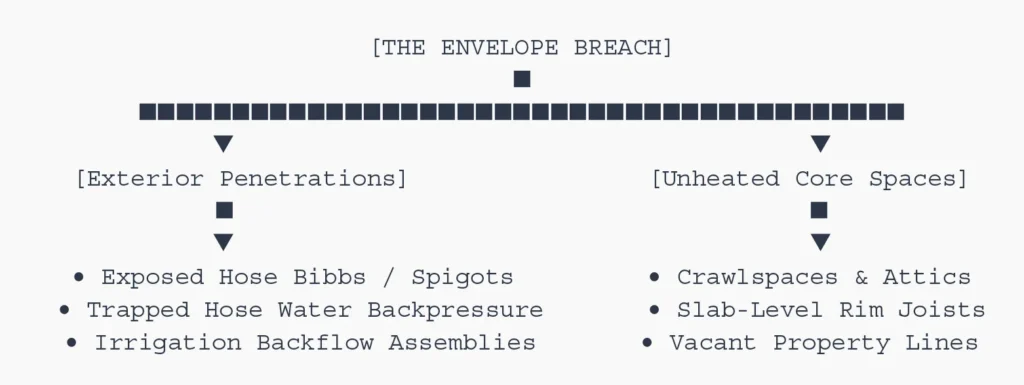
Flashpoint 1: Outdoor Hose Bibbs and Spigots
A standard outdoor faucet protrudes directly into freezing sub-zero air. If a homeowner leaves a garden hose attached over the winter, the hose traps a continuous column of water inside the faucet body. As that water freezes, the ice expansion splits the internal copper tube situated just inside the home’s conditioned wall cavity.
Flashpoint 2: Irrigation Backflow Preventers
Lawn sprinkler systems utilize external brass backflow assemblies that sit entirely above ground. Because brass is an excellent thermal conductor, it drops to freezing temperatures rapidly. Trapped water inside the valve body freezes instantly, cracking the expensive internal brass castings and plastic check valves.
Flashpoint 3: Pipes in Unheated Crawlspaces and Attics
Plumbing lines routed through unconditioned crawlspaces, unheated attics, or cantilevered overhanging floors are highly vulnerable. Even a microscopic gap in the home’s exterior siding allows a cold air draft to hit a pipe directly, dropping the local temperature below 32°F in minutes, regardless of how warm the rest of the house is.
WARNING: The ‘Frost-Free’ Spigot Illusion is a Common Trap!
Modern ‘frost-free’ hose bibbs are designed to shut off water deep inside the heated house structure. However, they only work if they are pitched downward to drain completely. If you leave a garden hose attached, or if the spigot was installed backwards with an incorrect pitch, water remains trapped inside the barrel, completely neutralizing the frost-free safety design and guaranteeing a burst.
3. Professional Diagnostics and Autumn Execution Protocols
True winterization requires a systematic, top-to-bottom drain-down of vulnerable plumbing matrices before the first hard frost of autumn arrives.
The Winterization Safeguard Protocol:
- Isolation and Bleed-Down: Technicians locate the internal shut-off valves for all exterior spigots inside the home. The internal valve is closed completely, and the exterior faucet is opened to drain the line. Crucially, the technician opens the small brass ‘bleeder cap’ on the interior valve to release the vacuum, ensuring 100% of the trapped water escapes.
- Pneumatic Irrigation Blow-Out: For lawn sprinkler systems, professionals hook up a high-volume commercial air compressor directly to the main irrigation line. Compressed air is systematically cycled through every single zone to physically blow all water clear of the underground lines and backflow valves.
- Conditioned Barrier Reinforcement: Plumbing lines running through vulnerable crawlspaces are retrofitted with heavy-wall polyethylene foam insulation. For extreme conditions, self-regulating electric heat trace cables are integrated along the run to dynamically maintain pipe temperatures above freezing.
- Anti-Siphon & Multi-Turn Upgrades: Legacy outdoor spigots are upgraded to modern, heavy-duty ASSE-certified frost-free hydrants featuring built-in vacuum breakers, permanently eliminating the human error of winter prep.