
1. The Root Problem: The Destructive Force of High Pressure
Many homeowners assume that higher water pressure is always better. However, municipal water mains frequently deliver water at highly volatile pressures—often exceeding 100 to 150 Pounds per Square Inch (PSI) to ensure it can reach towers and fire hydrants. For a standard residential home, any pressure consistently above 80 PSI turns water into a destructive force.
The Long-Term Effects on Your Home:
- Fixture and Appliance Degradation: High pressure accelerates wear and tear on internal components. It forces water past delicate seals, stretches rubber diaphragms, and prematurely burns out the intake valves on expensive appliances like dishwashers and washing machines.
- Micro-Leaks and Pipe Stress: Constantly straining under extreme pressure forces pipe joints, solder points, and flexible supply lines to flex and weaken. This stress results in hidden pinhole leaks behind drywall and sudden, catastrophic pipe bursts.
- Fixture Erosion: High velocity water physically erodes the brass and ceramic cartridges inside your faucets and shower valves, causing permanent drips and requiring early replacements.
2. The Three Essential Pillars of Pressure Management
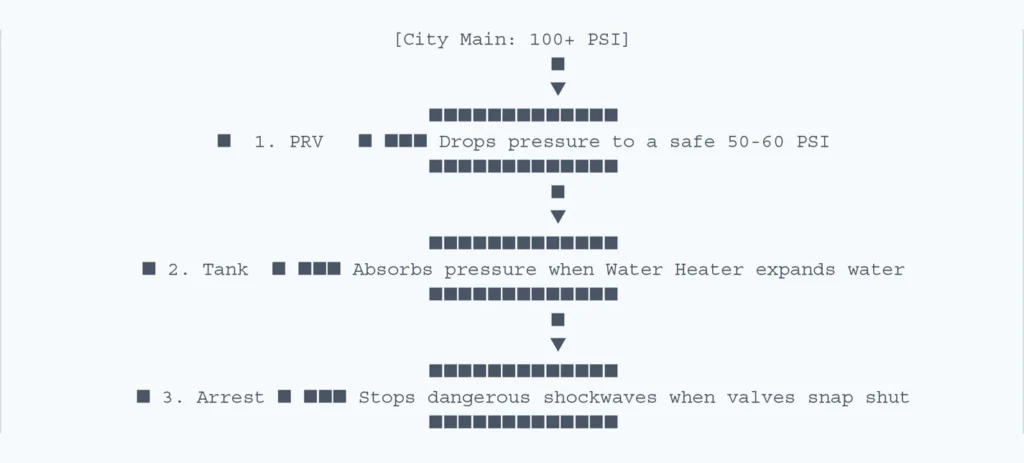
Protecting a home from pressure-related destruction requires a complete system-wide defense. A professionally configured plumbing system relies on three vital components working together to tames water
movement.
Component 1: The Pressure Reducing Valve (PRV)
- What it does: The PRV is your home’s primary shield. Installed right after the main water shut-off valve, it takes the high, unpredictable municipal water pressure and drops it down to a safe, steady residential baseline—typically between 50 and 65 PSI.
- How it fails: PRVs contain an internal rubber diaphragm and spring that wear out over time. When a PRV fails, it often allows city pressure to bleed entirely into the house, exposing all your fixtures to maximum danger.
Component 2: The Thermal Expansion Tank
- What it does: Water expands when it is heated. When your water heater runs, the expanding water needs somewhere to go. Because modern plumbing systems are ‘closed systems’ (thanks to backflow preventers and PRVs), that expanding water has no escape, causing pressure spikes up to 120+ PSI several times a day. An expansion tank acts as a safety cushion, using a pressurized air bladder to safely absorb that extra water volume.
- How it fails: If the internal rubber bladder ruptures, the tank fills completely with water and loses its ability to cushion the system. This leaves your water heater safety valve dripping and subjects your pipes to constant thermal pressure spikes.
Component 3: Water Hammer Arrestors
- What it does: Modern appliances like washing machines, dishwashers, and smart faucets use fast-closing solenoid valves that snap shut in milliseconds. When moving water is stopped that quickly, its kinetic energy creates a violent shockwave called ‘water hammer.’ Arrestors are small cylinders containing a gas-charged piston installed right next to these valves. They act as shock absorbers, catching the impact of the rushing water before it can shake your pipes.
- How it fails: Older homes used ‘air chambers’ (simple vertical pipes) that eventually filled with water and stopped working. Modern mechanical arrestors can eventually lose their gas charge over years of hard use, leaving your pipes to rattle and bang when appliances run.
WARNING: The “Banging Pipe” Illusion is a Structural Warning Sign!
Hearing a loud thud, click, or rattle in your walls when a faucet turns off or the washing machine switches cycles is not just an annoying noise—it is the sound of your plumbing system tearing itself apart. Those shockwaves can reach over 300 PSI momentarily, snapping pipe hangers, loosening fittings, and splitting copper lines over time.
3. Professional Diagnostics and System Restoration
Because high pressure is completely invisible and often silent until a leak occurs, preventative professional tracking is the only way to safeguard your property.
The Pressure Protection Protocol:
- Static and Dynamic Testing: A professional plumber installs specialized diagnostic gauges to monitor both static pressure (when no water is running) and thermal expansion spikes over a 24-hour window to map the system’s true stress level.
- Complete System Harmonization: If pressure issues are detected, technicians calibrate a new PRV to a safe threshold, match a new expansion tank’s air charge exactly to the home’s incoming pressure, and mount engineered hammer arrestors directly onto high-risk appliance lines.
- Whole-House Health Inspection: Following stabilization, a thorough check of toilet fill valves, appliance hoses, and faucet cartridges is performed to locate and replace any hidden components that were previously weakened by high pressure.